



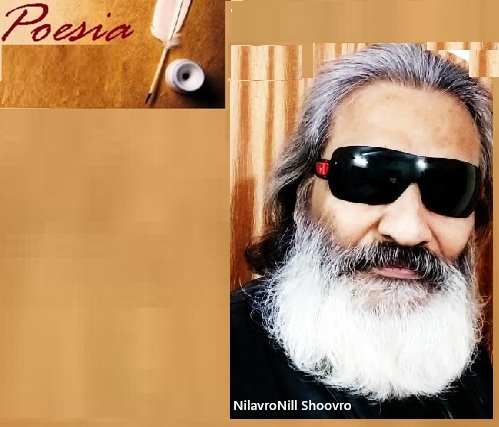
Nel vasto panorama della poesia contemporanea, una voce potente e visionaria arriva da Calcutta, in India. NilavroNill Shoovro, autore delle raccolte “Unsigned Epitaph” e “Nude Melodies”, si muove con trasversalità tra la scrittura poetica e l’impegno civile. Conosciuto a livello internazionale non solo come poeta ma anche come fondatore e curatore della rivista web mensile “Our Poetry Archive”, il suo lavoro è una lente che cattura il dolore, l’intimità e la complessità della condizione umana. Le sue opere sono state tradotte in italiano, francese, tedesco, spagnolo e in molte altre lingue europee e asiatiche, testimonianza del suo respiro globale.
L’autore, è anche un prolifico saggista che affronta temi scottanti come attualità, affari internazionali e filosofia. La sua poetica è stata definita dal Dr. Jernail Singh Anand (poeta professore emerito presso l’Istituto Europeo di Studi e Ricerca su Roma di Belgrado) come “un sapore unico”, espressa con la “finezza e grazia di un uomo di lettere consumato”. Un’altra voce critica, la dott.ssa Aprilia Zank, descrive Shoovro come un maestro nell’indagare la “fragilità della condizione umana, l’amore deperibile e l’impermanenza di valori e sentimenti”, sottolineando la sua capacità di trasformare la negazione in affermazione. La poetessa polacca Alicja Maria Kuberska lo descrive come un artista capace di affascinare con la sua “sottile poetica e sensibilità verso il mondo che lo circonda”, e ha curato l’edizione polacca della sua opera.
Al cuore pulsante della missione letteraria di Shoovro non c’è solo l’arte, ma una precisa responsabilità etica. Come scrive lo stesso poeta: “La poesia richiede compassione umana. Senza di essa, la poesia diventa solo un ammasso di parole morte, vuote, un’entità senza vita”. Su una nota ancora più profetica, in un editoriale per la sua rivista, Shoovro ha affermato che lo “Scopo della poesia” non può essere passivo, ma deve istigare un “dialogo attraverso la comunicazione delle anime”, una “comunicazione della simpatia” in grado di trasformare l’io del poeta in un noi universale, capace di rispondere alle urgenze del presente.
Ispirato da Adrienne Rich e dalla capacità della poesia di creare crepe nel muro degli spettacoli politici, la sua opera è una tensione costante. Lo testimoniano le sue parole piene di amarezza: “Noi, che lavoriamo con le parole e le emozioni, abbiamo fallito. Abbiamo fallito nel promuovere l’amore e la compassione”. È in questa prospettiva che la sua poesia diventa un atto di resistenza civile. Un esempio emblematico di questo approccio è il componimento del 6 gennaio 2024, “So che sto morendo”, quasi una preghiera laica per un mondo in fiamme:
So che sto morendo
Lo so, sto morendo ogni giorno
Lentamente ma costantemente,
troppo debole
Per sperare in una resurrezione
Almeno si può sperare, o credere
Lo so, sto morendo ogni giorno
Con ogni ora che cresce
Inevitabilmente irreversibile
Una spinta verso
Il conto alla rovescia finale
Lo so, sto morendo ogni giorno
Con ogni corpo morto, disteso
Morto sotto le macerie…
Sotto un pesante bombardamento
Davanti agli occhi, senza vergogna
Lo so, sto morendo ogni giorno
Testimoniando quegli orfani,
Feriti e senza casa
Senza riparo, senza cibo
Niente a cui aggrapparsi per sopravvivere
Lo so, sto morendo ogni giorno
Lentamente, ma inevitabilmente, perché
Non so come rimanere
Allegro, compiacente come gli altri
Testimone di un genocidio….

NilavroNill Shoovro: Poetry as a Testimony of Pain and History
In the vast landscape of contemporary poetry, a powerful and visionary voice comes from Calcutta, India. NilavroNill Shoovro, author of the collections “Unsigned Epitaph” and “Nude Melodies”, moves with versatility between poetic writing and civic commitment. Known internationally not only as a poet but also as the founder and editor of the monthly web journal “Our Poetry Archive”, his work is a lens that captures pain, intimacy, and the complexity of the human condition. His works have been translated into Italian, French, German, Spanish, and many other European and Asian languages, a testament to his global reach.
The author, is also a prolific essayist tackling pressing issues such as current affairs, international politics, and philosophy. His poetics have been described by Dr. Jernail Singh Anand (Poet Professor Emeritus at the European Institute of Roma Studies & Research, Belgrade) as having “a taste of its own,” expressed with the “finesse and grace of a seasoned man of letters.” Another critical voice, Dr. Aprilia Zank, describes Shoovro as a master in investigating the “fragility of the human condition, perishable love, and the impermanence of values and feelings,” highlighting his ability to transform negation into affirmation. Polish poet Alicja Maria Kuberska describes him as an artist capable of captivating with his “subtle poetics and sensitivity toward the world around him,” and she curated the Polish edition of his work.
At the beating heart of Shoovro’s literary mission lies not only art but a precise ethical responsibility. As the poet himself writes: “Poetry requires human compassion. Without it, poetry becomes just a heap of dead, empty words, a lifeless entity.” On an even more prophetic note, in an editorial for his journal, Shoovro stated that the “Purpose of poetry” cannot be passive, but must instigate a “dialogue through the communication of souls,” a “communication of sympathy” capable of transforming the poet’s ‘I’ into a universal ‘we’, responsive to the urgencies of the present.
Inspired by Adrienne Rich and by poetry’s ability to create cracks in the wall of political spectacles, his work is in constant tension. This is evidenced by his bitter words: “We who work with words and emotions have failed. We have failed to promote love and compassion.” It is from this perspective that his poetry becomes an act of civil resistance. An emblematic example of this approach is the poem dated January 6, 2024, “I Know I’m Dying”, almost a secular prayer for a world in flames:
I Know I’m Dying
I know, I’m dying each day
Slowly but steadily,
Too weak
To hope for a resurrection
One can hope though, or believe
I know, I’m dying each day
With every passing hour
Inevitably irreversible
A push towards
The final countdown
I know, I’m dying each day
With every dead body, lying
Dead under the rubble…
Under heavy shelling
Before the eyes, shamelessly
I know, I’m dying each day
Witnessing those orphans,
Wounded and homeless
Unsheltered, unfed
Nothing to hold on to survive
I know, I’m dying each day
Slowly, but inevitably, because
I don’t know how to remain
Cheerful, complacent like others
Witnessing a genocide….
Author Profile

Latest entries
 Cultura9 Agosto 2026L’AMORE CHE NON COGLIE IL FIORE
 Cultura2 Agosto 2026IN BILICO TRA I MONDI – Lo Sguardo e la Memoria nella Poesia di Silla Campanini
 Letteratura e Poesia26 Luglio 2026IL SECOLO CHE NON HA IMPARATO – Szymborska e la Nostra Contemporaneità
 Arte19 Luglio 2026IL DONO DI SOMMA VESUVIANA – Quando l’Archeologia diventa Ponte tra Culture e Custode del Futuro